In today’s increasingly complex pharmaceutical supply chain, ensuring the authenticity and safety of prescription drugs is more important than ever.
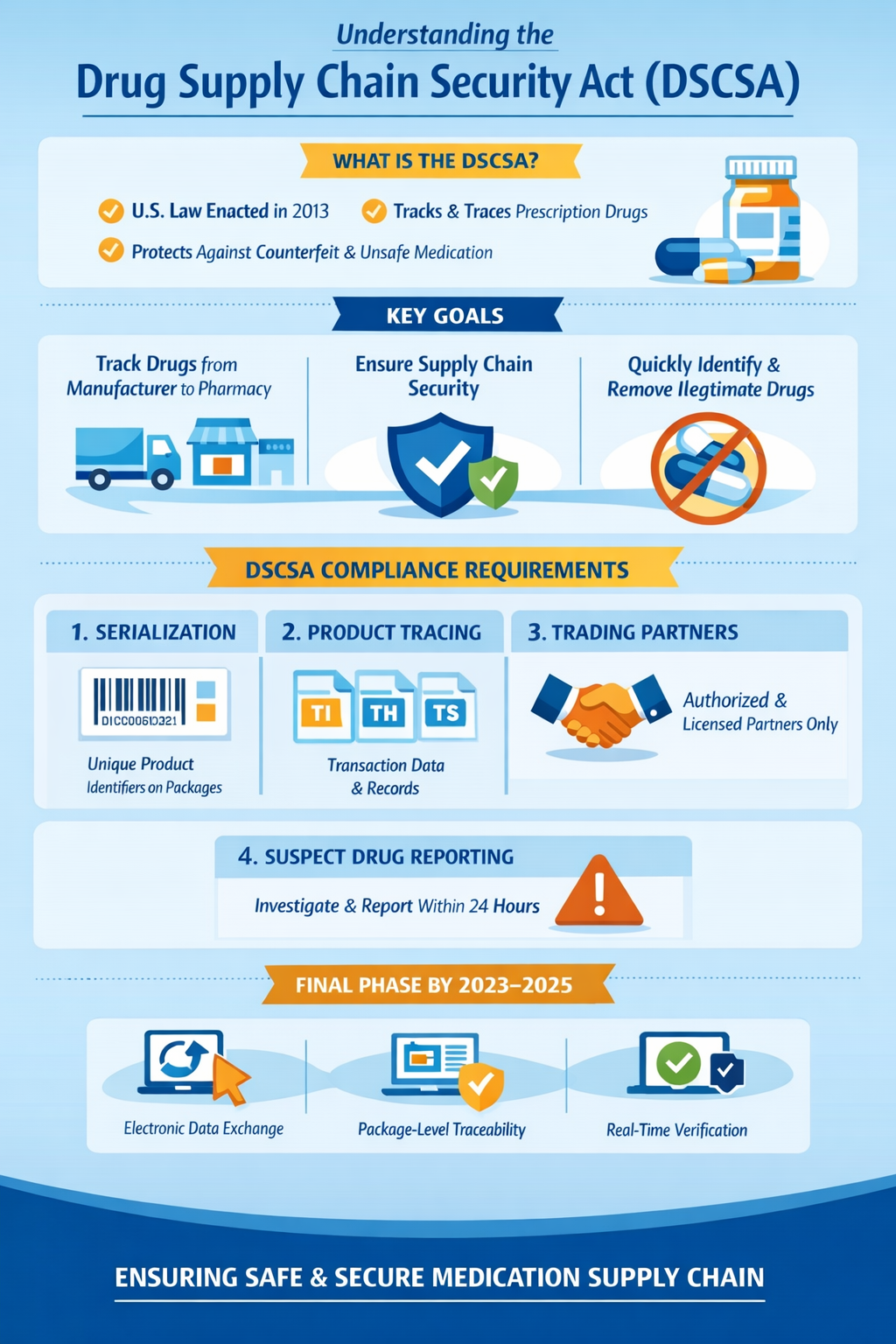
The Drug Supply Chain Security Act (DSCSA) was enacted in 2013 to strengthen the integrity of the U.S. drug supply chain by creating a system that enables the tracking and tracing of prescription medications as they move from manufacturer to patient. Lean Biologix ensures your company meets all DSCSA requirements, providing the strategic support needed to bridge any compliance gaps.
What Is the DSCSA?
The Drug Supply Chain Security Act established a national framework designed to prevent counterfeit, stolen, or otherwise illegitimate drugs from entering the U.S. market.
At its core, the law requires trading partners across the pharmaceutical supply chain to maintain visibility and accountability for prescription drug products through standardized data exchange and traceability requirements.
The long-term objective is a fully interoperable electronic system capable of tracing prescription drugs at the package level across the entire supply chain.
Why the DSCSA Is Important
The global pharmaceutical supply chain spans multiple organizations, countries, and logistics providers. Without a unified system of traceability, identifying and responding to compromised drug products can be extremely difficult.
The DSCSA addresses this risk by introducing several key safeguards:
- Improved patient safety – By enabling rapid identification and removal of counterfeit or contaminated medicines.
- Supply chain transparency – Every transaction involving prescription drugs must be documented, allowing companies to trace the origin and distribution path of each product.
- Faster recalls and investigations – When quality issues arise, traceability data allows organizations to determine quickly where affected products were distributed.
- National regulatory consistency – The DSCSA replaced a patchwork of state-level pedigree laws with a single federal framework governing pharmaceutical traceability.
Core Compliance Requirements
To comply with the DSCSA, pharmaceutical companies and other trading partners must meet several operational requirements.
Product Serialization
Prescription drug packages must contain a unique product identifier, typically encoded in a 2D data matrix barcode. This identifier includes:
- National Drug Code (NDC)
- Unique serial number
- Lot number
- Expiration date
Serialization enables individual packages to be uniquely identified and verified throughout the supply chain.
Transaction Documentation and Traceability
Whenever ownership of a drug product changes, supply chain partners must exchange specific transaction data:
- Transaction Information (TI): product details such as NDC, lot number, and quantity
- Transaction History (TH): the chain of ownership for the product
- Transaction Statement (TS): certification that the transaction complies with DSCSA requirements
Authorized Trading Partners
Companies are permitted to conduct pharmaceutical transactions only with authorized trading partners, which include licensed manufacturers, repackagers, wholesalers, dispensers, and registered third-party logistics providers.
Ensuring that supply chain partners meet licensing and regulatory requirements is a critical aspect of DSCSA compliance.
Final Thoughts
The Drug Supply Chain Security Act represents one of the most significant regulatory changes to pharmaceutical distribution in the United States. By introducing serialization, traceability, and verification requirements across the supply chain, the law strengthens patient safety while increasing transparency and accountability throughout the industry.
Organizations that invest in strong DSCSA compliance programs today will be better positioned to maintain operational efficiency, protect product integrity, and build trust across the healthcare ecosystem.