
Before a biotechnology company can bring a therapy to market, CMC must demonstrate more than clinical efficacy and patient safety; it also needs to display comprehensive evidence that the product can be consistently manufactured, traced, tested, and distributed throughout its lifecycle including supply chain. This critical body of information is known as Chemistry, Manufacturing, and Controls (CMC).
CMC serves as the bridge between scientific innovation and commercial reality. Whether developing a monoclonal antibody, cell therapy, gene therapy, mRNA therapeutics, viral vector products, recombinant protein, or vaccine, a robust CMC strategy is essential for regulatory approval, manufacturing scalability, and long-term product success.
What is CMC?
Chemistry, Manufacturing, and Controls refers to the section of regulatory submissions that describes how a pharmaceutical or biotechnology product is manufactured and controlled to ensure consistent quality.
The primary objective of CMC documentation is to demonstrate that every batch of product released to patients meets predefined standards for identity, strength, purity, potency, and safety.
Regulatory agencies including the U.S. Food and Drug Administration, European Medicines Agency, and Pharmaceuticals and Medical Devices Agency rely heavily on CMC data when evaluating Investigational New Drug (IND), Biologics License Application (BLA), New Drug Application (NDA), and Marketing Authorization Application (MAA) submissions.
A common misconception is that CMC activities occur only near commercialization. In reality, CMC development begins during early-stage research and continues throughout the entire product lifecycle.
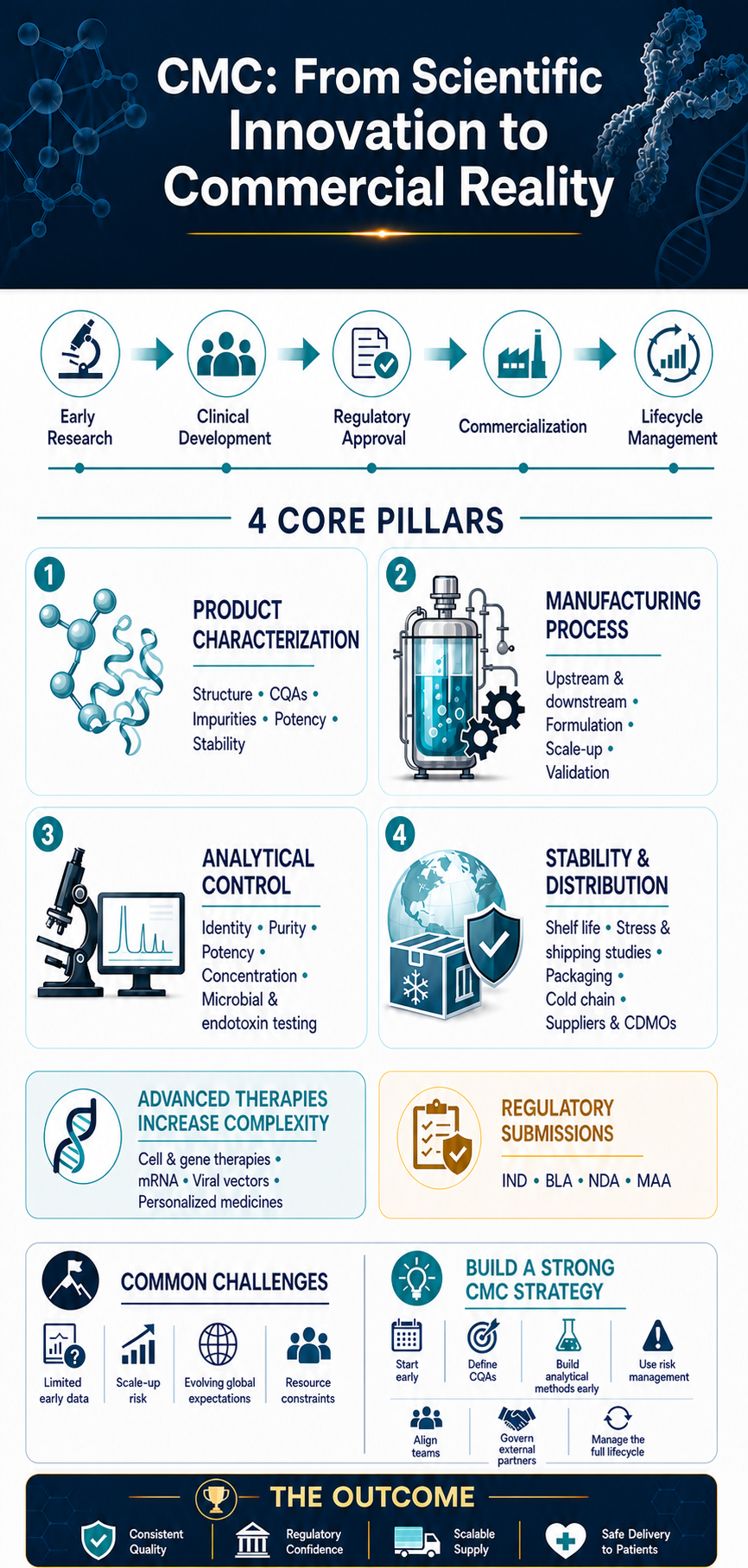
Key Components of a CMC Program
While the specific requirements vary depending on the product type and stage of development, most CMC programs include several core elements.
CMC and Supply Chain Management
One area receiving increased attention is the intersection of CMC and supply chain operations.
Modern biotech products frequently require:
- Temperature-controlled transportation
- Specialized packaging systems
- Real-time environmental monitoring
- Global distribution networks
- Third-party logistics providers
- Contract development and manufacturing organizations (CDMOs)
Because product quality must be maintained from manufacturing through patient administration, CMC strategies increasingly incorporate transportation and distribution controls.
This includes:
- Shipping qualification studies
- Lane risk assessments
- Packaging validation
- Cold-chain monitoring programs
- Supplier qualification activities
- Quality agreements with logistics partners
Regulators expect companies to demonstrate that product quality is protected throughout the entire distribution lifecycle, not simply within manufacturing facilities.
Best Practices for Building a Strong CMC Strategy
Successful biotech organizations typically follow several guiding principles:
- Begin CMC planning early in development.
- Establish a clear understanding of critical quality attributes.
- Develop robust analytical methods as early as possible.
- Incorporate risk management into all stages of development.
- Align manufacturing, quality, regulatory, and supply chain functions.
- Maintain strong oversight of CDMOs and external partners.
- Invest in lifecycle management rather than focusing solely on regulatory milestones.
A proactive approach often reduces costly delays and minimizes regulatory risk.
Conclusion
As therapies become more complex and supply chains become increasingly global, the importance of strong CMC programs will only continue to grow. Organizations that integrate scientific rigor, quality systems, manufacturing excellence, and supply chain oversight into their CMC strategy position themselves for successful clinical development, regulatory approval, and long-term commercial success.
What can Lean Biologix (LBX) do to help?
The LBX team has extensive experience with equipment and shipping qualifications. LBX can develop, evaluate, and execute equipment and shipping qualifications for a customer’s review while being compliant with the current industry and regulatory standards. LBX has helped successfully qualify equipment for product or coolant storage and shipping system for product protection from physical damage and challenging thermal environments during distribution. For more information on shipping qualification, see the Design Qualification (DQ), Operational Qualification (OQ), and Performance Qualification (PQ) tabs under Supply Chain Testing Services on the LBX website.