
When qualifying packaging for air and ground transit, the packaging type dictates the required testing parameters. The physical hazards experienced by a 10-pound parcel traveling through automated sorting hubs differ drastically from a 1,200-pound palletized load moved by forklifts and air cargo.
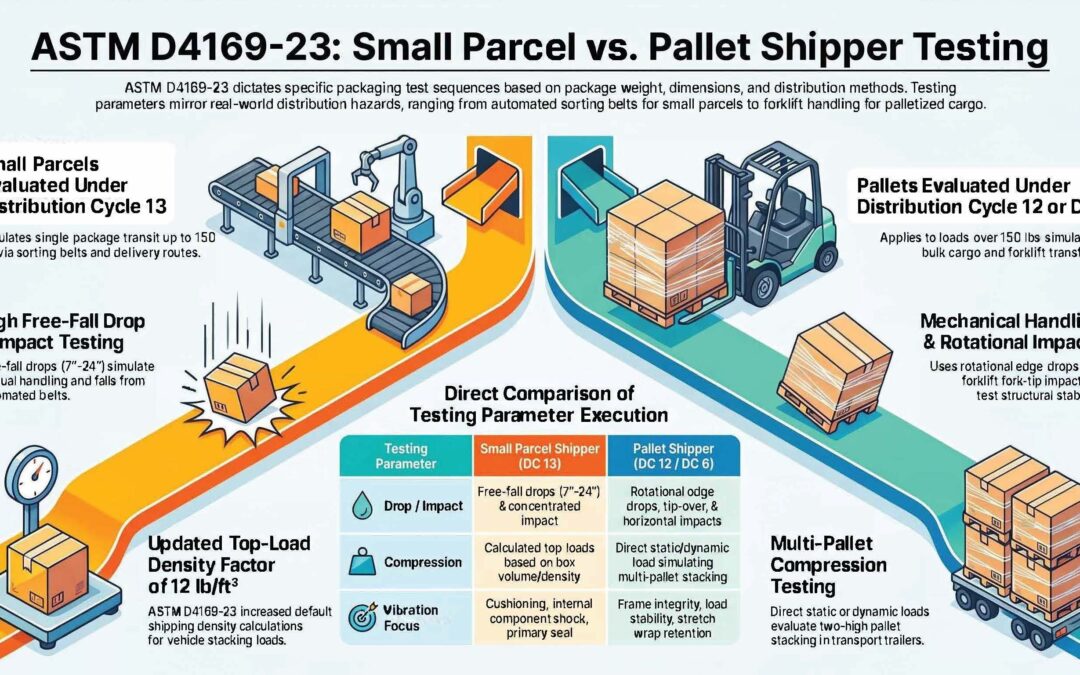
Under ASTM D4169-23 (Standard Practice for Performance Testing of Shipping Containers and Systems), pallet shippers and small parcel shippers follow distinct test sequences to simulate real-world logistics and distribution. A summary of the comparison between testing small parcel and pallet shippers per ASTM D4169 can be seen in the table below.
Distribution Cycle (DC) Selection
ASTM D4169 categorizes distribution paths into specific Distribution Cycles (DCs) based on modes of transit and handling methods. Typical distribution cycles used for small parcel and pallet shippers will be evaluated for this article’s purpose.
- Small Parcel Shipper: Evaluated under DC 13 (Air and motor freight, single package up to 150 lb). This cycle simulates individual parcel handling, automated sorting belts, air cargo transport, and local delivery van routes.
- Pallet Shipper (Unitized Load): Evaluated under DC 12 (Air and motor freight, over 150 lb or unitized load) or DC 6 (Motor freight, unitized). These cycles simulate bulk cargo handling, forklift transfers, truck trailer loads, and air deck loading.
Shock and Handling Hazards (Schedule A & J)
How impact forces are applied during testing depends on package mass and handling method:
- Small Parcel (Manual Handling): Subjected to free-fall drop tests onto corners, edges, and flat faces. Drop heights (often ranging from 7 to 24 inches depending on Assurance Level and weight) reflect manual throwing or falling off sorting belts. Parcels are also subject to Concentrated Impact (Schedule J) to simulate damage from adjacent packages crashing into them on conveyors.
- Pallet Shipper (Mechanical Handling): Pallets undergo rotational edge drops, forklift fork-tip impacts, and/or stability/incline impact testing. The goal is to evaluate pallet frame integrity, skid resistance, and containment stability under forklift or pallet jack maneuvers rather than high free-fall drops. Pallet shippers are also subject to Concentrated Impact (Schedule J) to simulate damage from accidental crashes into other packages or surroundings.
Compression and Vehicle Stacking with Vibration (Schedule D or C & E)
Both shipper types must withstand top loads during road transit or flight, but calculations vary under ASTM D4169-23 guidelines:
- Small Parcel: Vehicle stacking load is calculated using standard top-load formulas based on container dimensions and other factors. The ASTM D4169-23 revision updated the default shipping density factor from 10 to 12 lb/ft³, increasing top-load weight requirements for standard boxes. Furthermore, packages defined as “small and light” (weighing under 10 lbs and under 2 ft³) use a reduced stack height factor (54 inches instead of 108 inches) to avoid unrealistic crushing.
- Pallet Shipper: Dynamic or static compression testing reflects full pallet loads stacked two-high in air freight lower decks or ground trailers.
Altitude Stresses (Schedules E & I)
Because both shippers travel via air and ground for DC 12 and DC 13, both undergo low-pressure altitude testing (Schedule I):
|
Testing Parameter |
Small Parcel Shipper (DC 13) |
Pallet Shipper (DC 12 / DC 6) |
|
Drop / Impact Test |
High free-fall drops (7″–24″) & Concentrated Impact |
Rotational edge drops, tip/tip-over tests, horizontal impact |
|
Compression |
Top loads from other packages |
Direct static/dynamic load simulating multi-pallet stacking |
|
Vibration |
Cushioning, internal component shock, primary seal fit |
Structural integrity, stretch wrap retention, load stability |
|
Low Pressure (Air) |
Verifies primary/secondary packaging pressure seals (if applicable) |
DC 12 only: Verifies bulk shipper containment and insulation seals (if applicable) |
What can Lean Biologix do to help?
The LBX team has extensive experience with shipping qualifications of both small parcel and pallet shipping systems. LBX can develop, evaluate, and execute shipping qualifications based on a customer’s supply chain while being compliant with the current industry and regulatory standards. LBX has helped successfully qualify small parcel and pallet shipping systems for product protection from physical damage and challenging thermal environments during distribution. For more information on shipping qualification, see the Design Qualification (DQ), Operational Qualification (OQ), and Performance Qualification (PQ) tabs under Supply Chain Testing Services on the LBX website.