
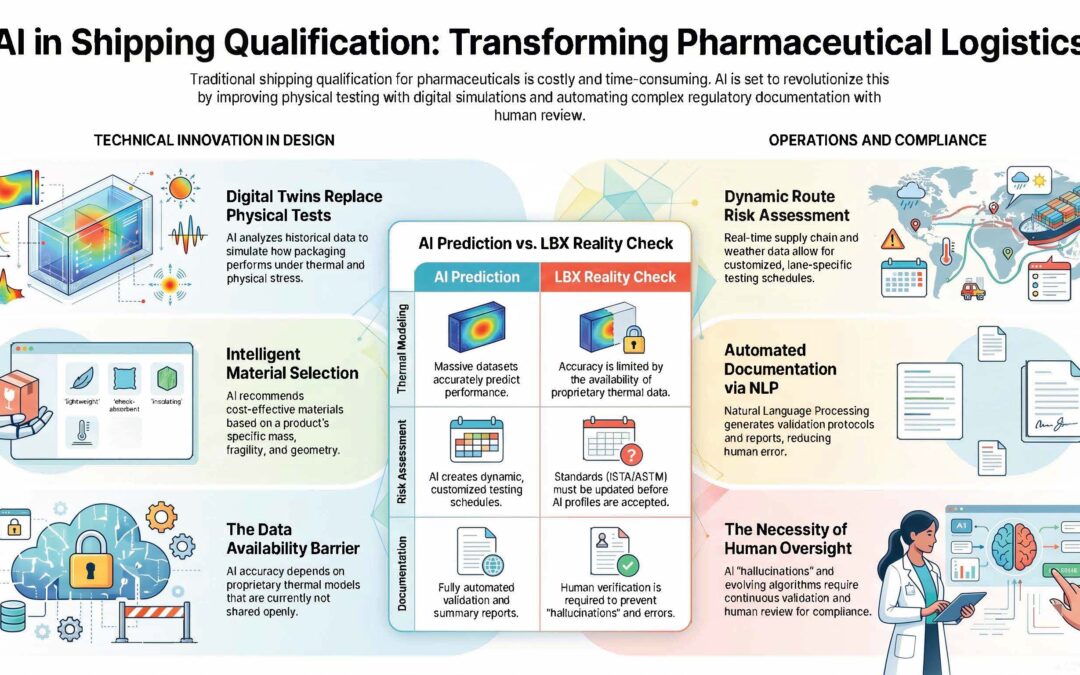
AI’s impact on shipping qualification and compliance.
Shipping qualification ensures that packaging systems can protect high-value products like pharmaceuticals and biologics and is notoriously rigorous, costly, and time-consuming. However, Artificial Intelligence (AI) and machine learning are poised to revolutionize supply chain.
Using the latest AI model, LBX generated the following list of potential impacts that AI may have on the shipping qualification process. Table 1 compares AI predictions and LBX’s predictions (as of June 2026) on AI’s impact on shipping qualification and compliance.
|
# |
Potential Impact to Shipping Qualification |
AI Predictions |
LBX Predictions |
Comparison |
|---|---|---|---|---|
|
1 |
Predictive thermal and kinetic modeling to predict whether a packaging design is adequate and speed up the DQ phase |
AI algorithms can analyze massive datasets of historical testing data to accurately predict how a specific packaging configuration will perform under various ambient conditions and physical stresses. This digital simulation (often utilizing “digital twins”) significantly reduces the need for repeated, expensive physical tests and speeds up the Design Qualification (DQ) phase. |
Thermal modeling for predicting a packaging design’s ability to maintain a required temperature will improve with AI. The accuracy of AI will be dependent on availability of existing thermal models of current packaging. However, thermal modeling results corroborated with actual thermal laboratory testing are typically proprietary for shipper manufacturers and not shared openly. In terms of characterizing shipping lanes thermally (custom thermal profiles), logistics control towers are beginning to create a supply chain database. |
Industry will need to create a platform to crowdsource thermal modeling information to accelerate the accuracy of thermal modeling and thermal qualification process for new shipper designs. ISTA Digital is one platform that has been leading the industry on crowdsourcing supply chain information. |
|
2 |
Optimizing packaging design and materials |
AI can analyze the physical properties of a product—such as its mass, fragility, and geometry—to instantly recommend the most cost-effective packaging materials and the most accurate representative materials for testing. |
Similar to thermal modeling, the accuracy of AI will be dependent on the knowledge database on material characterizations, such as density, cost, fragility, conduction. Some companies have begun to build their confidential database of material characteristics. With AI, these companies will become the frontrunners in providing custom packaging solutions to customers. |
Agreement with the AI predictions with the caveat on the availability of material characteristics needed for suggesting the optimal packaging solution. |
|
3 |
Advanced route risk assessment |
AI can ingest real-time supply chain data, weather patterns, and historical transit routes to create highly customized, dynamic testing schedules. Instead of relying solely on general standards, companies could use AI to test against the exact predicted hazards of their specific distribution lanes, resulting in a more robust lane management process. |
AI has already affected the decision-making for commercial distribution. Tive and Roambee are AI-powered supply chain visibility platforms for real-time tracking of shipments that have been implemented at some companies. Distribution OQ standards will need to be updated to permit the use of AI-generated hazard profiles for the proposed supply chain. In terms of PQ testing, PQ testing will continue to be required to demonstrate shipping process verification at a minimum until the advanced route risk assessment is matured and recognized by regulatory agencies. |
AI is beginning to be incorporated into supply chain decisions with tools, such as through temperature monitoring device platforms or 3rd party logistics control towers. Distribution standards from ISTA and ASTM will need to evaluate and incorporate the possibility for use of AI-generated hazard profiles for OQ testing. |
|
4 |
Automated compliance and documentation |
Natural Language Processing (NLP), a branch of AI, can assist in automatically generating validation protocols, technical justifications, and final summary reports. This not only reduces human error but ensures that documentation stays perfectly aligned with ever-changing global regulatory standards. |
In the coming years, semi-automated compliance and documentation may be adopted after rigorous evaluation and testing, including human verification. In April 2026, FDA issued an AI-focused warning letter (“Purolea Cosmetics Lab – 722591 – 04/02/2026”). Completely automated compliance and documentation is improbable because AI is at risk of “hallucinations” and may generate erroneous content, which will require careful human review. AI can’t be validated by standard validation methods (static testing) because AI evolves with machine learning. AI platforms will have to undergo continuous validation through trending of the platform’s accuracy. |
Validating AI platforms for documentation may be a key issue before documentation and compliance can be fully automated. In the interim, humans should continue to review AI-generated content. |
What can Lean Biologix do to help?
LBX can support the implementation of devices and related software tools for tracking shipments (e.g., logistics control towers), monitoring compliance, and integrating multiple data sources to make smarter decisions in Supply Chain compliance. The LBX team has extensive experience with shipping qualifications and GxP computer systems validation (CSV). Our expertise in CSV is crucial in ensuring compliant application of AI or any software tools in a regulated environment.